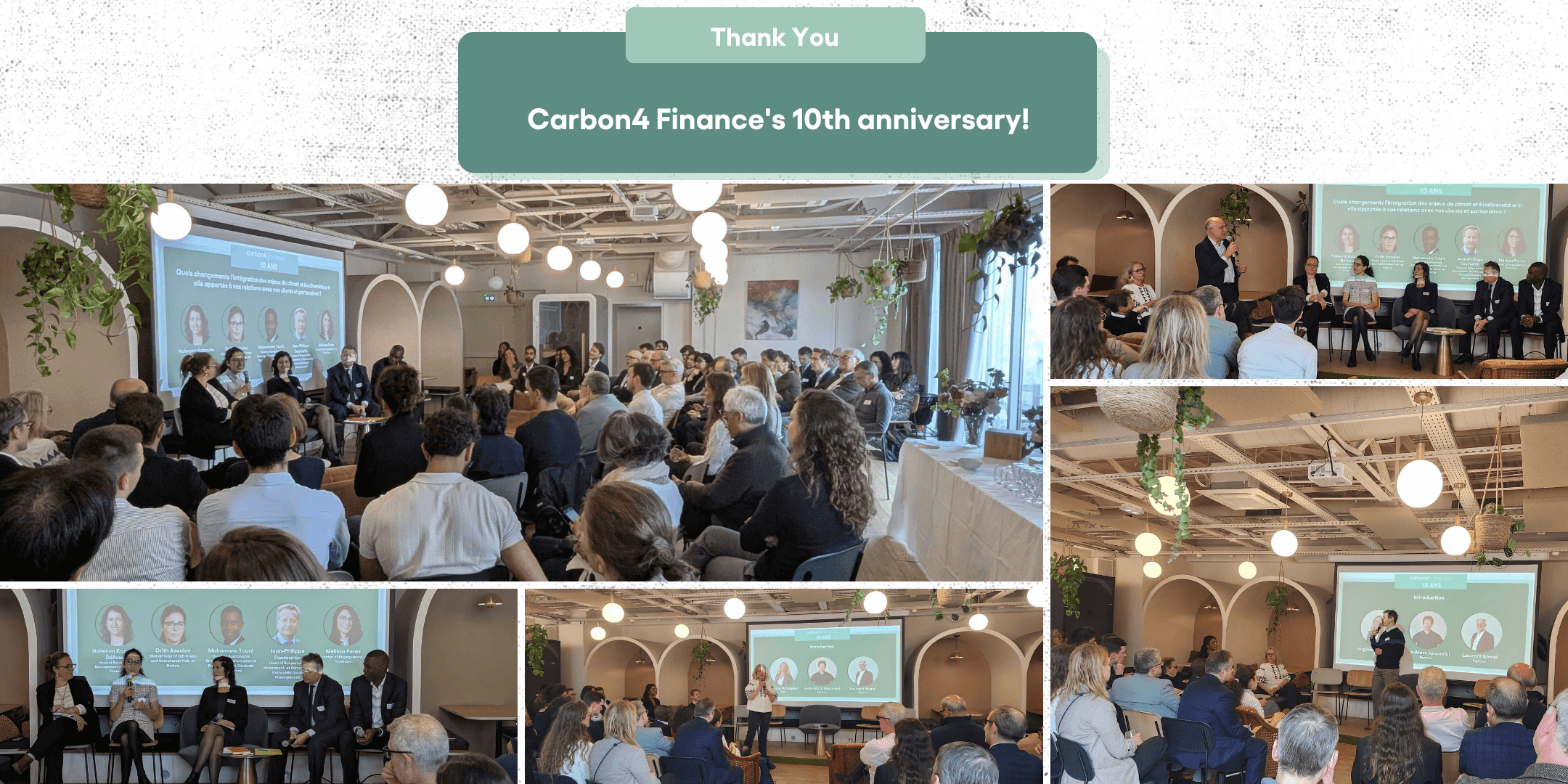
Carbon4 Finance's 10th anniversary!
INFORMATIONS
Climate House
his event was an opportunity to reaffirm to our audience the Carbon4 Finance DNA, which is based on a deep understanding of industrial processes and physical constraints, ensuring independent and comparable data. Unlike many traditional players in the financial information market who have only recently diversified into ESG, Carbon4 Finance is inherently an expert in climate and nature that designs its own methodologies and datasets, as noted by Jean-Marc Jancovici, co-founder of Carbone 4.
Virginie Wauquiez, CEO, outlined the profound transformation of Carbon4 Finance, which has evolved from a startup developing methodologies into a robust and independent organization, organized into centers of expertise, capable of supporting its clients in their climate and biodiversity strategies and in understanding risks and dependencies. Our teams continue to share the same commitment to continuous innovation, enabling us to be pioneers in the calculation of avoided emissions, to launch our biodiversity database (BIA-GBS) in 2021, and, more recently, to deploy our Climate Bonds analysis solutions.
Our roundtable also provided an opportunity to hear the perspectives of four clients with complementary profiles: Orith Azoulay (Natixis, representing the banking sector), Jean-Philippe Desmartin (EDRAM, representing the asset management sector), Mahamane Touré (Société Générale Assurances, representing the insurance arm of a banking group), and Mélissa Perez (Tutélaire, representing a mission-driven mutual insurance company).
Together, they shared the concrete challenges of integrating climate and biodiversity issues into the strategies of various financial institutions:
- Clarity of objectives: The need to set clear, ambitious, and measurable trajectories using the right indicators. All of this takes place in a context where regulators are continually refining their requirements and where NGOs maintain heightened vigilance.
- Operational implementation: The complex transition from theory to practice, from choosing a measurement method to adapting processes and IT tools. The issue is no longer simply having ESG data, but having data that is understandable, open to discussion, and useful for decision-making.
- The connection with the saver: The challenge of linking these financial solutions to retail clients and their savings. This represents a major challenge in terms of education, training intermediaries, and transforming the investment process.
If you have any questions regarding our solutions or the use cases presented, we would be delighted to discuss them with you: https://www.carbon4finance.com/contact